Learn Chinese Kung Fu
Interested in learning authentic Chinese Kung Fu and internal martial arts?
WeChat: 17085311333
Please add the note: kungfu
Email: zhangzhiyong614@gmail.com
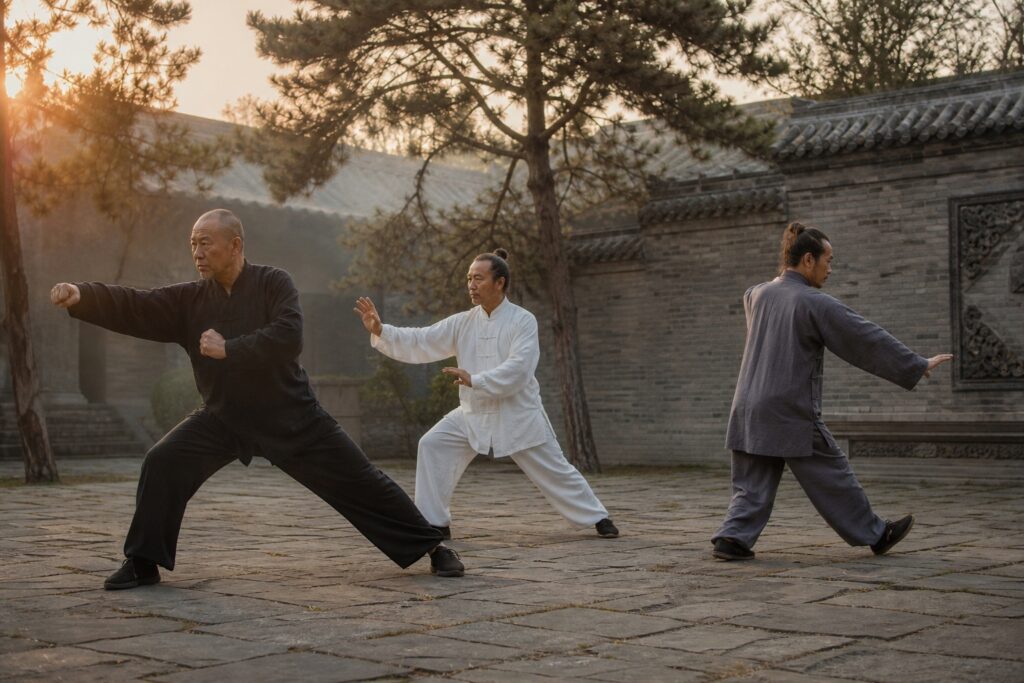
When people hear the words “Chinese Kung Fu,” they often imagine spectacular kicks, rapid punches, acrobatic movements, or scenes from martial arts films. These images are exciting, but they represent only a small part of the Chinese martial arts tradition.
Chinese Kung Fu is not simply a collection of fighting techniques. It is a broad system of physical training, self-defense, health cultivation, mental discipline, and traditional philosophy. Within this vast tradition is an important group of martial arts commonly known as the “internal martial arts,” or Neijiaquan.
What exactly is Chinese Kung Fu? What makes a martial art “internal”? And how are Xingyiquan, Taijiquan, and Baguazhang related?
What Does “Kung Fu” Really Mean?
The Chinese term gongfu, usually written as “kung fu” in English, does not originally mean martial arts.
It refers to a skill developed through time, effort, patience, and disciplined practice. A musician may have good kung fu. A skilled carpenter, calligrapher, cook, or doctor may also be said to possess kung fu.
In other words, kung fu is not a particular movement or fighting style. It is the ability that emerges after long and serious training.
Outside China, however, “Kung Fu” has become a general name for Chinese martial arts. In this sense, Chinese Kung Fu includes hundreds of different styles, training systems, weapons, combat methods, and regional traditions.
Some styles emphasize powerful hand techniques. Others specialize in kicking, wrestling, joint control, weapons, close-range fighting, or agile footwork. Their outward appearances may be very different, but they share a common principle: genuine skill must be cultivated through correct and persistent practice.
Chinese Kung Fu Is More Than Fighting
Combat ability has always been an important part of traditional martial arts. Historically, people trained to protect themselves, their families, their communities, and sometimes their country.
Yet Chinese Kung Fu gradually developed into something broader than fighting alone.
Training the Body and Mind
Traditional training may include:
- Basic stances and stepping methods
- Punches, kicks, throws, and joint-control techniques
- Solo forms and partner exercises
- Weapons training
- Strength, flexibility, and coordination
- Breathing and concentration practices
- The study of strategy and body mechanics
- Character development and martial ethics
A complete martial art trains both body and mind. The practitioner learns how to generate power, maintain balance, respond to pressure, control distance, and remain calm in changing circumstances.
For this reason, traditional teachers often say that martial arts training is also a process of understanding oneself.
What Are the Internal Martial Arts?
The term Neijiaquan is commonly translated as “internal martial arts” or “internal boxing.”
The Three Principal Internal Systems
Today, it most often refers to three major systems:
- Xingyiquan
- Taijiquan
- Baguazhang
Some other styles may also be described as internal, but these three are generally regarded as the principal representatives.
Efficient Whole-Body Coordination
The word “internal” does not mean that the arts are mysterious, magical, or concerned only with invisible energy. It refers primarily to the way the body is trained and organized.
Internal martial arts seek to connect the entire body so that movement is produced by a coordinated structure rather than by isolated muscular effort. The legs, hips, waist, spine, shoulders, arms, and hands must work together as one integrated unit.
The goal is not to avoid using muscles. Every physical movement requires muscular activity. The real objective is to eliminate unnecessary tension and use strength more efficiently.
Internal Does Not Mean Soft or Weak
One of the most common misunderstandings is that internal martial arts are always slow, gentle, and relaxed, while external martial arts are fast, hard, and powerful.
This distinction is too simple.
Internal martial arts can be explosive and forceful. Xingyiquan, for example, is famous for direct attacks, decisive stepping, and powerful whole-body strikes. Baguazhang contains rapid changes of direction, evasive footwork, throws, and close-range attacks. Taijiquan also includes strikes, joint controls, throws, and sudden issuing of power.
Relaxation in internal martial arts does not mean becoming limp or weak. It means releasing unnecessary tension while maintaining structure, awareness, and readiness.
A relaxed body can change more quickly. A connected body can transmit power more efficiently. A sensitive body can detect and respond to an opponent’s force before that force becomes overwhelming.
True softness contains strength, and true strength must remain adaptable.
The Role of Structure
Structure is one of the foundations of internal martial arts.
Whole-Body Power Without Rigidity
Good structure allows force to travel through the whole body. When the feet press against the ground, that force is organized through the legs, directed by the waist and torso, and expressed through the hands.
This is often described as “whole-body power.”
If the body is disconnected, the arm moves by itself and the strike depends mainly on local muscular strength. If the body is connected, the hand becomes the final point of a movement generated by the entire structure.
Correct structure does not mean holding the body rigidly. A rigid structure may appear strong, but it is often unable to adapt when the direction of force changes.
The structure of internal martial arts must be stable yet mobile, relaxed yet supported, centered yet capable of turning, folding, rising, sinking, advancing, and retreating.
The Importance of the Dantian
Internal martial arts frequently refer to the dantian, especially the lower dantian located in the lower abdominal region.
The dantian should not be understood simply as a mysterious source of supernatural power. In practical training, it can be viewed as an important center for balance, breathing, coordination, and whole-body movement.
When practitioners are told to “move from the dantian,” they are being taught not to move only the arms and shoulders. Movement should be organized from the center and transmitted through the entire body.
Over time, the practitioner develops a stronger connection between intention, breathing, posture, and movement. The body begins to act as one unit rather than as a collection of separate parts.
Xingyiquan: Directness and Unified Power
Xingyiquan is often translated as “Form-Intent Boxing.”
It is known for direct movement, aggressive strategy, and powerful forward energy. Its techniques may appear simple, but the internal mechanics are highly refined.
A central part of Xingyiquan training is San Ti Shi, the Three-Body Posture. This posture develops alignment, balance, leg strength, whole-body connection, and awareness of opposing forces within the body.
Xingyiquan also uses the Five Element Fists:
- Pi Quan — Splitting Fist
- Beng Quan — Crushing Fist
- Zuan Quan — Drilling Fist
- Pao Quan — Cannon Fist
- Heng Quan — Crossing Fist
These are not merely five hand techniques. They are five fundamental methods of organizing movement, force, and intention.
Xingyiquan teaches the practitioner to unite intention and action. Once a decision is made, the whole body advances together without hesitation.
Taijiquan: Balance, Sensitivity, and Transformation
Taijiquan, commonly known as Tai Chi, is the most internationally recognized internal martial art.
Many people practise it for relaxation and health, but traditional Taijiquan is also a sophisticated combat system.
Taijiquan emphasizes balance, continuity, sensitivity, and the transformation of force. Rather than meeting strength with strength, the practitioner learns to receive, redirect, neutralize, and return the opponent’s power.
Slow-form training allows students to examine posture, coordination, weight transfer, and unnecessary tension in detail. However, the art itself is not limited to slow movement. Advanced Taijiquan includes fast techniques and explosive power known as fajin.
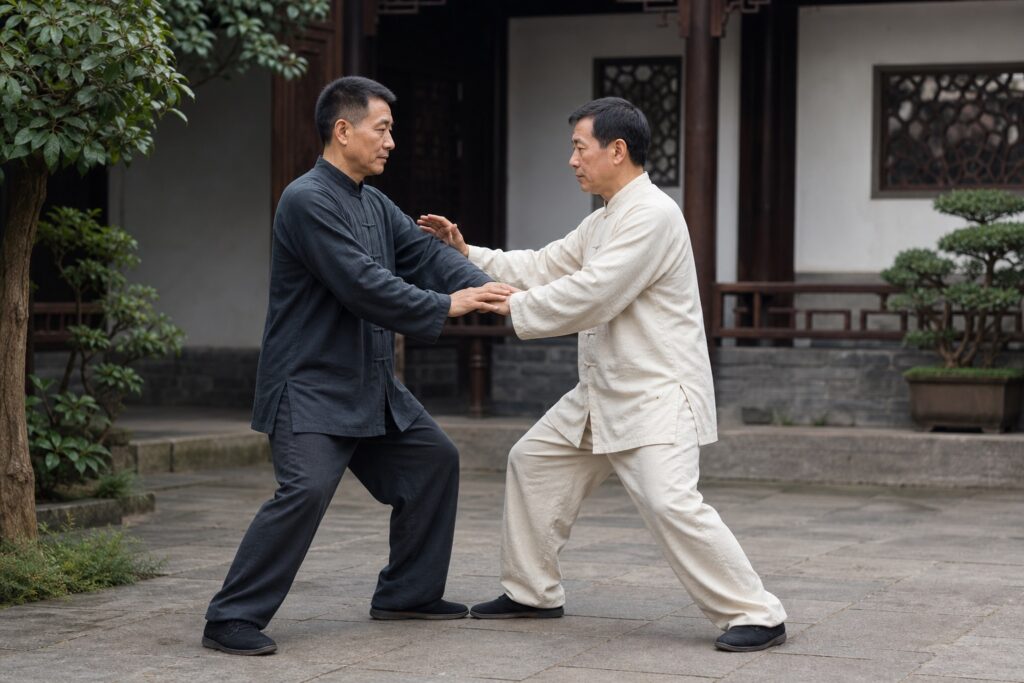
Push-hands training teaches practitioners to feel changes in pressure, direction, balance, and intention through physical contact.
The deeper lesson of Taijiquan is not simply to become soft. It is to remain centered while constantly changing.
Baguazhang: Movement, Change, and Circular Strategy
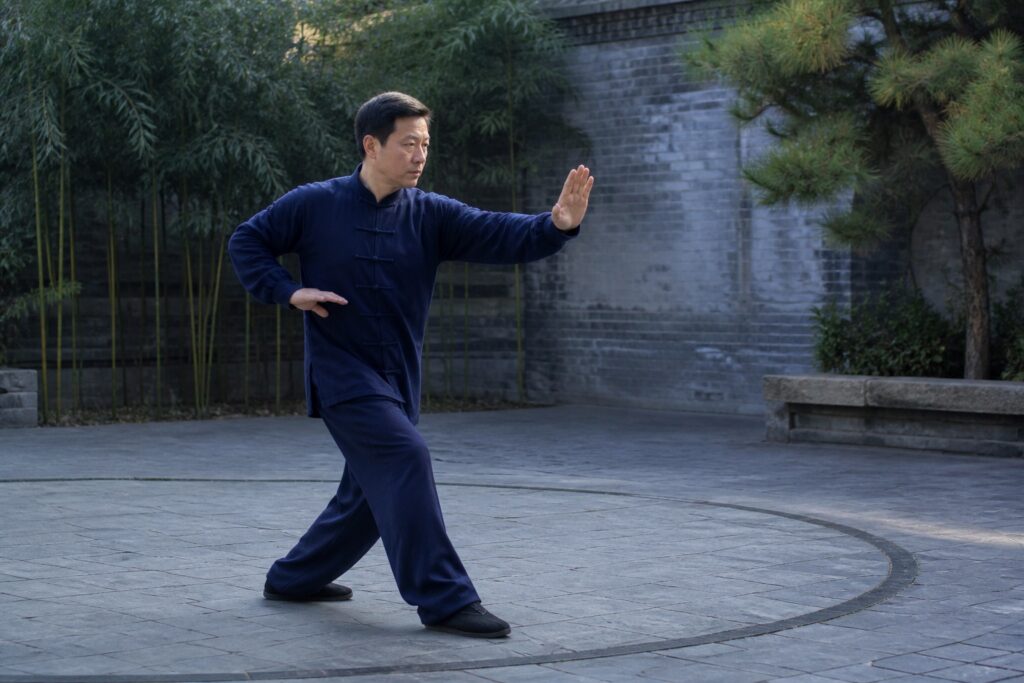
Baguazhang, or “Eight Trigram Palm,” is famous for circle walking, changing palms, spiraling movement, and flexible footwork.
Where Xingyiquan often enters directly, Baguazhang frequently changes angles. The practitioner moves around the opponent, avoids direct confrontation, and searches for a superior position.
Its movements train the body to twist, coil, open, close, rise, and sink while remaining connected. Constant changes of direction develop balance, coordination, and spatial awareness.
Baguazhang demonstrates one of the central ideas of internal martial arts: the body must remain organized even during complex movement.
What Do the Three Internal Arts Share?
Xingyiquan, Taijiquan, and Baguazhang look different and use different strategies, but they share several important principles.
All three emphasize:
- Whole-body connection
- Coordination between intention and movement
- Efficient rather than excessive muscular force
- Rooting and balance
- Movement directed from the center
- Relaxation without collapse
- Stability during change
- Sensitivity to force and direction
- The integration of mind, body, and breath
Their strategies may be summarized simply: Xingyiquan emphasizes direct entry, Taijiquan emphasizes neutralization and transformation, and Baguazhang emphasizes changing angles and positions.
This summary is useful, but no authentic martial art can be reduced to a single characteristic. Each system contains direct and circular movement, hardness and softness, attack and defense, stillness and change.
Is Qi a Mysterious Power?
Discussions of internal martial arts often include the Chinese concept of qi.
Qi has been interpreted in many different ways. Depending on the context, it may refer to breath, vitality, internal sensation, functional energy, or the coordinated activity of the body.
Problems arise when qi is presented as a magical power that replaces physical training and body mechanics.
Traditional descriptions of qi can be valuable, but they should be understood through practice. Breathing, posture, attention, relaxation, circulation, and coordinated movement can create powerful internal sensations. These sensations may help guide training, but they do not remove the need for structure, timing, strength, skill, and partner practice.
Internal power is not produced by imagination alone. It must be developed through the body.
Health and Martial Training
Many people now practise internal martial arts primarily for health.
Slow, attentive movement can help develop balance, coordination, mobility, body awareness, and mental calm. Standing practices may strengthen the legs and improve postural awareness. Regular training can also provide a structured way to reduce stress and remain physically active.
However, martial arts should not be treated as a guaranteed cure for disease or as a replacement for professional medical care.
Incorrect posture, excessive repetition, poor instruction, or training beyond one’s physical capacity may cause injury. Knees, hips, shoulders, and the lower back can be placed under unnecessary stress when movements are misunderstood.
Good training should be progressive and appropriate for the individual. Pain should not automatically be regarded as proof that the training is working.
The Importance of a Qualified Teacher
Why Direct Correction Matters
Books and videos can introduce movements and theories, but traditional martial arts are difficult to learn entirely without direct correction.
A beginner may imitate the external appearance of a posture while missing its internal organization. A hand position can look correct even though the shoulder is tense, the spine is disconnected, the weight is misplaced, or the knees are under excessive pressure.
A knowledgeable teacher can see and feel these errors. More importantly, the teacher can explain how a movement should function rather than merely how it should look.
A good teacher does not depend on mystery. The teacher should be able to demonstrate principles, correct students safely, and provide a clear progression from basic training to practical application.
Lineage can provide historical context, but a famous lineage alone does not guarantee skill. The quality of the teacher’s movement, understanding, teaching method, and character matters more than a prestigious name.
Kung Fu Requires Time
From Repetition to Natural Skill
Modern culture often promises quick results. Traditional Kung Fu follows a different rhythm.
Basic postures, stepping, and simple movements may need to be practised thousands of times. At first, students must consciously remember every detail. Gradually, correct movement becomes more natural. Eventually, the body begins to respond without deliberate thought.
This transformation is the real meaning of kung fu.
It cannot be obtained merely by collecting techniques or memorizing forms. Knowledge must be turned into physical ability through repeated, attentive practice.
Progress is not always visible. Sometimes the most important changes are subtle: improved balance, reduced tension, clearer timing, calmer breathing, and a stronger connection between the feet and hands.
Tradition Must Remain Alive
Chinese Kung Fu carries centuries of cultural knowledge, but respecting tradition does not mean copying old movements without understanding them.
A living tradition must preserve principles while continuing to test them through practice.
Historical texts, oral teachings, and old photographs can provide valuable clues. Yet these materials must be examined carefully. A photograph captures only one moment. A classical phrase may have several meanings. A movement that appears unusual may represent a transitional phase, a specific application, or an advanced body method.
The goal is neither to reject tradition nor to worship it blindly. The goal is to understand what the old teachers were trying to transmit.
Conclusion: What Is Chinese Kung Fu?
Chinese Kung Fu is the skill developed through long-term, disciplined martial practice. It includes fighting methods, health training, cultural traditions, strategy, ethics, and the study of human movement.
The internal martial arts are an important part of this tradition. They train practitioners to coordinate the body as a unified whole, direct movement from the center, reduce unnecessary tension, maintain balance under pressure, and combine intention with action.
Xingyiquan, Taijiquan, and Baguazhang express these principles through different methods. One advances directly, one specializes in transformation, and one is famous for continuous change. Beneath their differences, however, they share the pursuit of connected, efficient, intelligent movement.
Internal martial arts are not magic, and they are not simply slow exercise. They are practical systems that require patience, correct instruction, physical effort, and years of refinement.
To understand Chinese Kung Fu, we must look beyond dramatic performances and mysterious claims. Its deepest value lies in the process of training: learning to organize the body, steady the mind, respond intelligently to change, and transform repeated effort into genuine skill.