What Master Song Tielin’s Boxing Photograph Reveals About “Central Equilibrium”
Many martial artists have heard that the body must remain upright, centered, and balanced. In Chinese internal martial arts, this principle is often expressed as lishen zhongzheng, or “maintaining central equilibrium.” It is treated as one of the most important rules in training—as though allowing the torso to lean even slightly were a serious mistake.
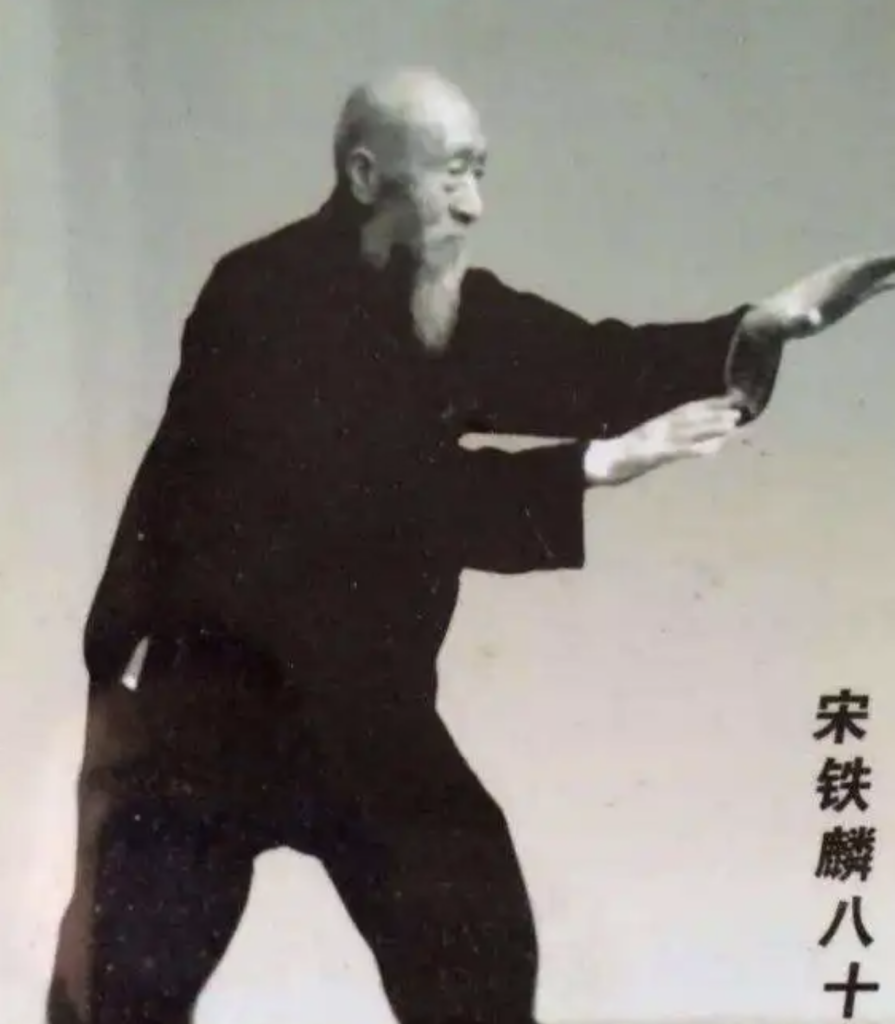
Yet historical photographs of renowned Xingyiquan masters tell a more complicated story.
In a boxing photograph taken when Master Song Tielin was around eighty years old, his torso inclines slightly forward. At such an advanced age, the posture demonstrated by a master of his stature was hardly accidental; it reflected a lifetime of genuine practice.
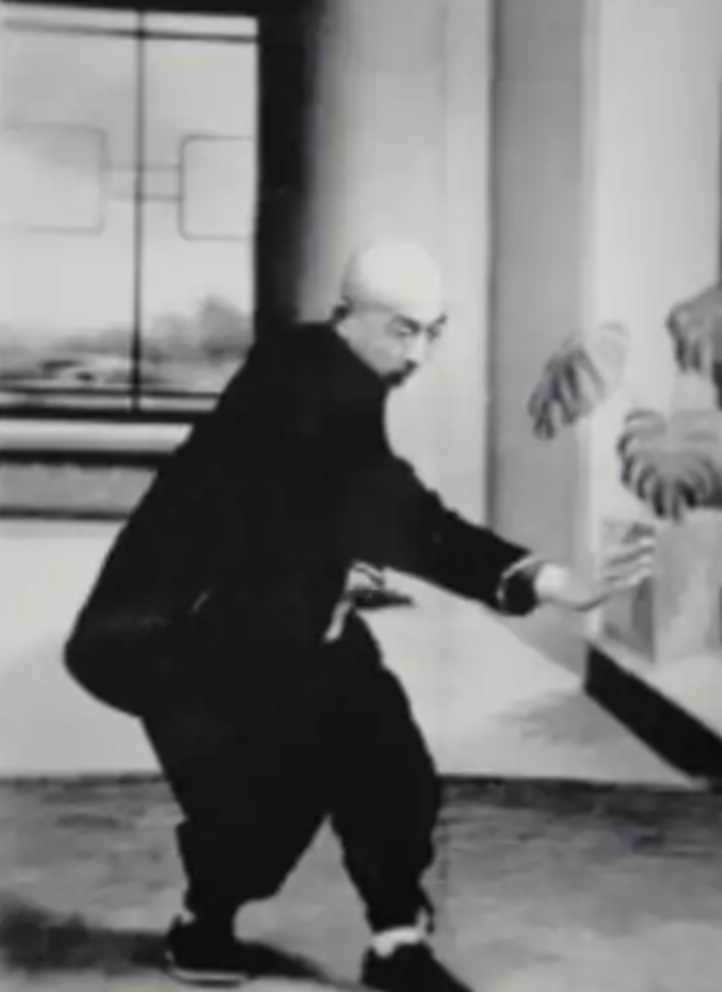
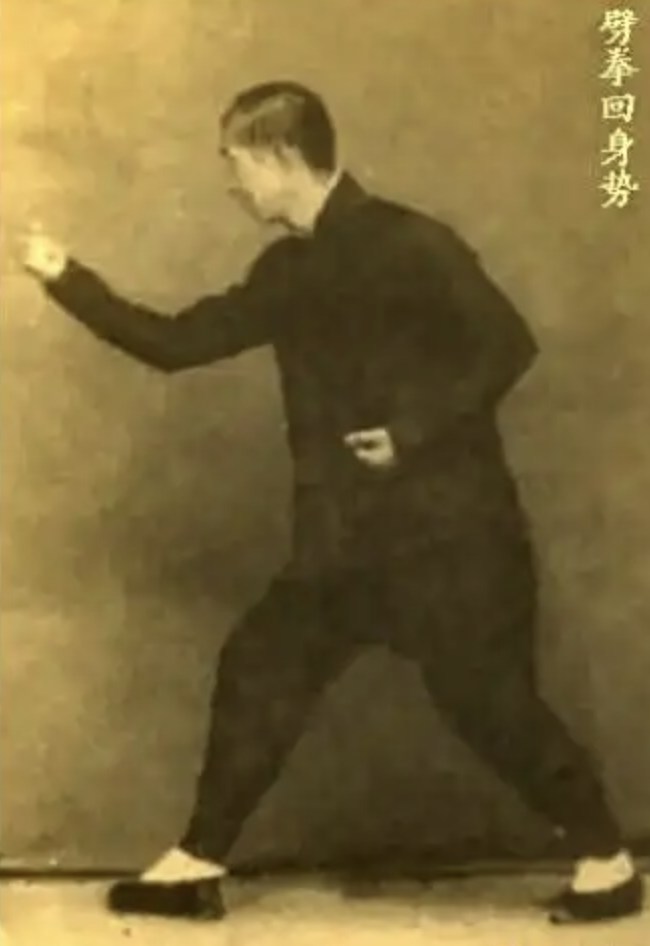
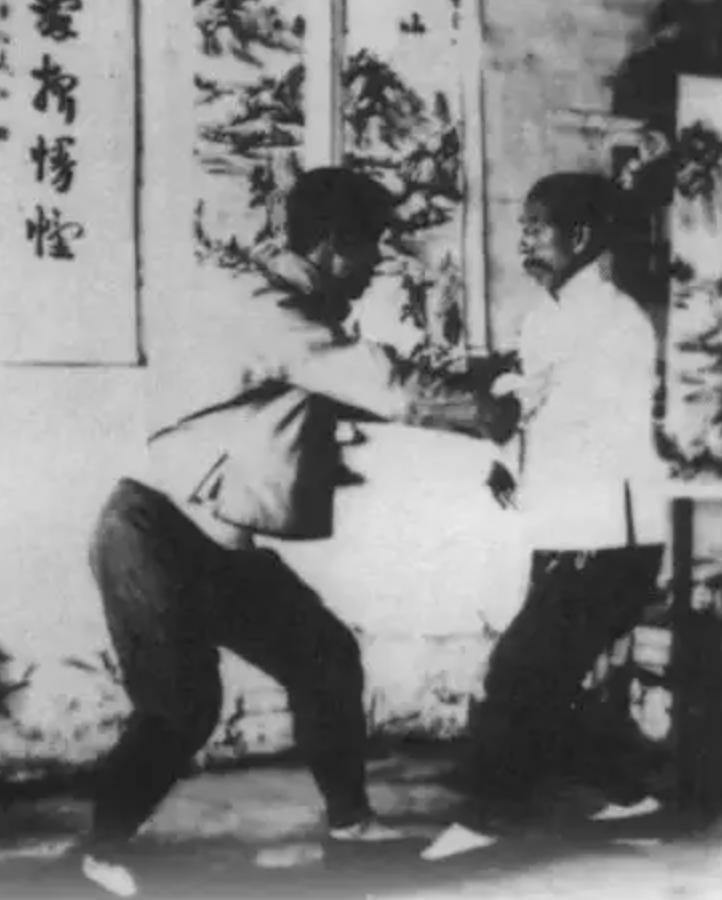
The same phenomenon can be seen elsewhere. Sun Lutang leaned slightly forward while turning in Pi Quan, the Splitting Fist. Chen Hehai, a distinguished disciple of Fu Jianqiu, was also photographed with a subtle forward inclination. In the well-known push-hands photographs of Sun Lutang and his son, Sun Cunzhou, the elder Sun appears centered and upright throughout, while Sun Cunzhou repeatedly leans forward.
Similar observations have been made about the boxing of Xue Dian. In more recent times, the celebrated Xingyiquan master Lu Zongren taught a structural method in which all five elements—Pi, Beng, Zuan, Pao, and Heng—could involve forward inclination and folding of the body.
These examples suggest that the old masters did not understand “central equilibrium” in quite the same way many practitioners do today.
Central Equilibrium Does Not Mean Holding the Body Rigidly Vertical
The Problem with a Rigid Vertical Line
Imagine a vertical line drawn from the temple down to the Yongquan point on the sole of the foot. Many practitioners try to arrange their entire body along this line. During push-hands or other partner work, however, the opponent applies force from the front or rear. That force meets the vertical body structure almost at a right angle, leaving little room for absorption or adjustment.
As soon as force enters through the arms, it travels directly toward the feet. The practitioner’s center of gravity becomes unstable, and the structure can easily be displaced.
This is not true central equilibrium.
Xue Dian vividly described this problem in his boxing writings with the phrase:
“When the body stands like a pole, it is easily toppled.”
Structure Must Remain Alive Under Pressure
A body held rigidly upright resembles a wooden post. It may look correct, but it lacks the living adjustments required for genuine balance. Practising this way over a long period may also place unnecessary stress on the knees because the weight of the upper body is transmitted downward without adequate folding, rounding, or redistribution through the whole structure. The harder a person trains an unsuitable posture, the more that accumulated stress may matter.
Correct movement can support mobility, physical comfort, and general well-being—but only when the posture and mechanics are sound. This is why the quality of instruction matters greatly in traditional martial arts. Precise body method cannot be learned merely by copying the outward shape.
One of the keys lies in rounding the chest and back so that the torso becomes connected, responsive, and capable of receiving force.
Why a Rigidly Upright Stance Fails Under Pressure
If a practitioner develops the habit of holding the upper body straight and stiff while standing in Hunyuan Zhuang, the same habit will usually appear in San Ti Shi. Under pressure, an opponent’s forward force enters the body directly. Because the entire structure has been arranged like a single rigid line, the practitioner is easily uprooted.
No matter how many years one stands this way, time alone cannot correct a misunderstanding of the underlying mechanics. Practice produces skill only when the method itself is sound.
So what does genuine central equilibrium mean?
Sun Lutang and Sun Cunzhou: Two Stages of the Same Path
In the famous photographs of Sun Lutang practising with his son, Sun Lutang appears centered and upright almost the entire time. Sun Cunzhou, however, inclines forward on several occasions as he attempts to transmit force into his father.
This does not necessarily mean that Sun Cunzhou’s posture was wrong.
Why the Old Photographs Deserve Attention
Photography was neither cheap nor casual in that era. If Sun Cunzhou had been demonstrating a fundamentally incorrect movement, it is reasonable to assume that Sun Lutang would have corrected him before the photographs were taken. The images therefore deserve careful study rather than dismissal.
Modern practitioners often want to reproduce Sun Lutang’s mature, outwardly upright posture, but they are unwilling to travel the path represented by Sun Cunzhou’s forward and backward adjustments.
This point is worth repeating: we try to skip the decades of training through inclination, extension, folding, and recovery, and leap directly to the refined central equilibrium achieved by Sun Lutang.
Sun Cunzhou appears to have been around thirty years old in the photographs, yet his movement still displayed visible forward and backward inclination. Why, then, should a modern beginner expect to embody perfect central equilibrium from the first day of training?
Stable central equilibrium is cultivated through extensive practice. The fact that Song Tielin still chose to demonstrate a forward-inclined posture in his eighties does not prove that his movement was incorrect. On the contrary, it may have been his way of reminding later generations that merely looking upright is not enough.
Traditional Boxing Includes Both Forward and Backward Inclination
The Taijiquan Treatise states:
“When the opponent advances, the response becomes deeper; when the opponent rises, the response becomes higher.”
This classical passage shows that Taijiquan contains the dynamics of lowering, rising, inclining, and adjusting rather than a single fixed vertical posture.
Sun Lutang likewise wrote in The Study of Xingyiquan:
“Even in forms of extreme height, extreme forward inclination, extreme lowering, or extreme backward inclination, one must never depart from the single-weighted center of San Ti Shi.”
Preserve the Center While Changing Direction
The crucial point is not the absence of forward or backward movement. It is the preservation of the center throughout that movement.
Traditional martial arts frequently speak of issuing power from the dantian. If the torso never folds, inclines, opens, or closes, how can the dantian organize the body’s potential energy and produce the dynamic quality described in the classics as “the qi becoming vibrant and expansive”?
My Xingyiquan teacher, Han Yu, called rigidly upright boxing “zombie boxing.” The description is blunt, but remarkably accurate: the body may be vertical, yet it has lost its elasticity, responsiveness, and life.
Central Equilibrium Is an Achievement, Not a Starting Pose
True central equilibrium is the result of training.
The masters followed the requirements preserved in the boxing manuals. For decades they practised forward and backward inclination, opening and closing, rising and sinking, and increasingly subtle adjustments. Eventually, the external movement became so refined that little or no displacement could be seen, even though the internal structure remained capable of neutralizing and controlling an opponent’s force.
At that stage, central equilibrium was no longer a rigid pose. It had become an embodied skill.
Kung fu is developed through practice. Is it realistic to expect perfect movement without first passing through imperfect stages?
Thomas Edison reportedly tested a great many materials in the search for a practical electric-light filament. Expecting to achieve central equilibrium immediately is like expecting him to select the right material without conducting any experiments. Success may be possible in theory, but the chances are extremely small.
The lesson preserved in these old photographs is simple: do not confuse central equilibrium with stiffness, and do not confuse a vertical appearance with correct body mechanics. Forward and backward inclination are not necessarily violations of the principle. When trained correctly, they are part of the process through which living, adaptable balance is eventually developed.
True central equilibrium does not mean that the body never moves away from a vertical line. It means that, through every rise and fall, opening and closing, advance and retreat, the center is never lost.